
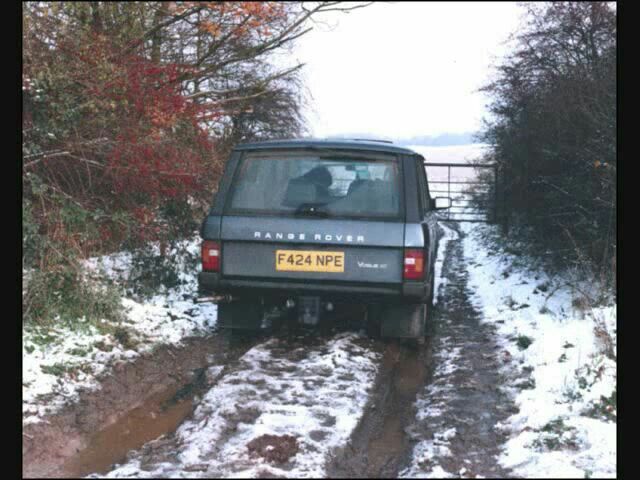
The Range Rover was not simply a random background detail. It was central to the case, central to the imagery, and central to how the event entered British popular memory. The number plate alone, F424 NPE, has since become recognisable to people who may not even know the full history of the incident. Like many notorious cars, the facts are scattered between early news reports, vehicle record websites, forum sightings, later documentaries and online folklore. Separating the known from the rumoured is where the story becomes properly interesting.
The Vehicle: A 1988 Range Rover Classic
The car linked to the Rettendon case was reported at the time as a metallic blue Range Rover with the registration F424 NPE. Later vehicle lookup records identify the registration as belonging to a blue 1988 Rover Range Rover, more specifically a Range Rover Vogue EFi automatic with a 3.5 litre V8 petrol engine. That places it firmly in the late 1980s Range Rover Classic period, before the second generation P38A Range Rover arrived in the 1990s.
In 1988, the Range Rover was already a status vehicle. It had started life in 1970 as a revolutionary blend of off-road ability and road comfort, but by the late 1980s it had moved well beyond its original agricultural image. A Vogue EFi was not just a farm truck with nicer seats. It represented the Range Rover’s transition into the luxury 4×4 world, with fuel injection, automatic transmission, a commanding driving position and the kind of understated wealth that suited country lanes, nightclub car parks and private roads equally well.
The 3.5 litre Rover V8 was part of the car’s character. Smooth, torquey and thirsty, it gave the Range Rover a very different feel from ordinary saloons of the era. The Range Rover Classic also used permanent four-wheel drive, coil-spring suspension and a 100 inch wheelbase. It was practical, comfortable, large enough to carry several adults, and imposing without being flash in the modern SUV sense. In mid-1990s Essex, a blue Range Rover Vogue made a certain kind of statement.
That matters because the vehicle was not just transport. It reflected a moment in British car culture when the Range Rover had become a symbol of money, control and countryside confidence. It could look respectable outside a rural property, expensive outside a nightclub and useful on an isolated farm track. That mix is partly why the image of F424 NPE endured. The same car that once represented British off-road luxury became frozen in public memory as a crime scene.
Why This Range Rover Became So Recognisable
Most crime-related vehicles disappear from public consciousness quickly. They are photographed, seized, examined, stored and either returned, auctioned, scrapped or forgotten. F424 NPE was different because the case became known by several names that kept the vehicle at the centre of the story. It was not only referred to as the Rettendon murders or the Essex Boys case, but also as the Range Rover murders. That nickname effectively turned the vehicle into the headline.
The early press reports were explicit about the car. The Independent reported on 8 December 1995 that two men were in the front of the metallic blue Range Rover, registration F424 NPE, while a third was in the back. The article also reported that the rear nearside window had been smashed, apparently by a shot, and that the vehicle was taken away on a police low-loader for forensic analysis. Those details helped fix the car in the public imagination almost immediately.
Another reason the vehicle became so recognisable is the recovery image. The Range Rover being removed from Workhouse Lane under a tarpaulin has been repeatedly shared and discussed over the years. Even people who avoid graphic crime material often recognise the image of the blue Range Rover on a transporter. It is one of those photographs where the vehicle becomes a silent historical object, carrying more weight than the frame itself shows.
Over time, the registration number gained its own strange afterlife. Car enthusiasts, true crime followers and forum users began searching MOT data, discussing possible sightings, debating whether the vehicle had been crushed, and questioning whether later records proved the original shell survived. F424 NPE became less like an ordinary number plate and more like a rolling mystery, even when the car itself may not have been rolling at all.
Where the Range Rover Was Found
The Range Rover was found on Workhouse Lane, near Rettendon, on the morning of 7 December 1995. Contemporary reporting described the location as a lonely lane or farm track near Chelmsford, close to the A130. The vehicle was discovered by farmer Peter Theobald and Ken Jiggins while they were on their way to feed pheasants in nearby fields. The location was rural, quiet and isolated enough for the parked Range Rover to seem at first like an obstruction rather than a national news story.
The early description of the scene is important because it tells us how the vehicle was positioned in the first known public record. It was not reported as crashed, rolled or abandoned after a chase. It was stationary. Police at the time said there were no obvious signs of a struggle inside the vehicle and no clear sign that anyone had tried to escape from it. That made the Range Rover more than a container for evidence. Its stillness was part of the story.
The vehicle’s position also explains why it became so tied to the landscape. Workhouse Lane was not a city street with CCTV, shopfronts or crowds. It was a place where a large blue Range Rover could sit in the cold darkness and be found only when someone needed to use the track. That contrast between a luxury 4×4 and a bleak rural setting helped give the case its enduring visual identity.
Police appealed for information about the Range Rover’s movements between 6pm on Wednesday 6 December and 8am on Thursday 7 December. That appeal shows how crucial the vehicle’s timeline was from the beginning. Who saw it, where it had been, who had access to it, and how it came to be on that track were all questions that made the car a central piece of the investigation.
The Damage to the Range Rover
The most clearly reported external damage was to the rear nearside window, which The Independent described as smashed, apparently by a shot. That detail is one of the most useful confirmed pieces of information because it comes from a contemporary report rather than later folklore. It tells us the vehicle showed visible damage at the scene, but it does not tell us everything that happened inside it.
Later discussion of the vehicle often becomes graphic, speculative or both, so it is worth keeping the confirmed detail separate from the mythology. The Range Rover was the location of a close-range shotgun attack, so the interior would have been heavily contaminated and extensively examined. However, many online descriptions of the cabin are based on second-hand claims, forum posts, social media comments or people claiming to have seen photographs. Those should not be treated with the same confidence as early reporting or formal records.
The important car-focused point is that F424 NPE would have been a major forensic exhibit. A vehicle used as the enclosed scene of a triple shooting would not be treated like a normal damaged car. Investigators would have been interested in blood pattern evidence, shot direction, cartridge evidence, fingerprints, fibres, trace material, seating positions, door and window status, and any sign of entry or exit. The vehicle itself was effectively a mobile room, and its surfaces would have been treated as evidence.
That forensic importance also explains why rumours about repair, cleaning and resale became so persistent. A car can have a smashed window replaced. A car can be valeted. A car can be mechanically repaired. But a vehicle with this kind of history is never psychologically restored in the eyes of the public. Even if every damaged part were replaced, the identity of the car would remain attached to what happened inside it.
Removed With the Bodies Still Inside
One of the most repeated details about the Range Rover is that it was removed from the scene with the bodies still inside. This is supported by early reporting, which stated that the Range Rover was lifted onto a police low-loader with the bodies still inside, covered by a tarpaulin, and taken away for forensic analysis. That detail has contributed heavily to the car’s grim reputation.
From an investigative point of view, moving the vehicle in that state can make sense. If the car itself is the primary scene, preserving the relationship between the occupants, seats, windows, doors, shot damage and interior evidence may be more important than removing bodies at the roadside. It allowed investigators to continue examining the vehicle in a controlled environment rather than exposing the scene further in a rural lane.
For the public, though, that image became unforgettable. A Range Rover Classic, already a distinctive British vehicle, was no longer just parked in a lane. It was lifted away as a sealed object of evidence. In many ways, that was the moment F424 NPE stopped being an ordinary car and became an artefact.
The fact it was covered by a tarpaulin also helped create mystique. People saw enough to know which vehicle it was, but not enough to see everything. That partial concealment made the recovery image more powerful. It left room for rumour, imagination and later retellings.
What Happened to the Range Rover After Forensics?
This is where certainty becomes much harder. The early confirmed record is clear enough: the Range Rover was taken away for forensic analysis. What happened after that is far less cleanly documented in publicly available sources. Unlike some famous crime vehicles, there does not appear to be a simple official public statement saying it was crushed, retained by police, auctioned, sold to a private collector or preserved in a museum.
That lack of a definitive public trail is the reason so many theories exist. Some people claim the original Range Rover was sold on. Some claim it was stripped, repaired and returned to road use. Some claim it was crushed. Others believe the number plate may have survived while the original body did not. The problem is that many of these claims rely on forum memory, social media hearsay or vehicle lookup records that prove a registration exists, but not necessarily that the same physical shell survived untouched from 1995.
Public vehicle data adds intrigue rather than certainty. Online registration history and driver-check sites have linked F424 NPE to a blue 1988 Rover Range Rover, with MOT records continuing into the 2000s. Rate Driver, for example, lists the vehicle as a blue Rover Range Rover Vogue EFi automatic, first registered on 1 November 1988, with a 3,528cc engine, and shows MOT history including a pass in July 2008 with an expiry in July 2009. RegHistory also identifies F424 NPE as a blue Land Rover Range Rover registered in November 1988.
Those records suggest that a vehicle under that identity continued to exist in administrative terms long after 1995. However, they do not answer the biggest question: was that vehicle still the original Rettendon Range Rover, the same shell repaired and returned to use, or a registration identity that later became attached to another vehicle? Without a full official chain of custody, it would be irresponsible to state one answer as fact.
Where Is F424 NPE Now?
The honest answer is that its exact present location is not publicly confirmed. Some public lookup-style records have described the registration as assigned to a blue 1988 Range Rover, with later administrative activity such as SORN or V5C references discussed online. RegHistory states that the registration is assigned to a vehicle and lists a Land Rover Range Rover, colour blue, registered November 1988, with an assignment date of 18 December 2020. Forum users and social media pages have also referred to SORN status and later logbook activity.
But a registration record is not the same as seeing the original car in a lock-up, museum, collection or scrapyard. UK vehicle identity can become complicated when cars are restored, re-shelled, cloned, repaired, broken for parts or simply misreported online. With a car as notorious as F424 NPE, there is also the added problem of deliberate imitation. The number plate itself has become famous enough that replicas, lookalikes and references can confuse the picture.
There have been claims that the vehicle was sold privately, claims that it appeared online for sale, and claims that it fetched or could fetch a large sum because of its notoriety. One tabloid report in 2021 suggested the Range Rover was set to raise a significant amount of money, but claims around sale prices and ownership need treating carefully unless backed by direct documentation. Notorious objects can attract inflated stories, especially when the audience already wants the mystery to continue.
The most balanced conclusion is this: F424 NPE remains active as a registration identity in public motoring folklore and appears in vehicle-record databases as linked to a blue 1988 Range Rover, but the location and authenticity of the original physical Rettendon vehicle are not publicly settled. That uncertainty is not a weakness in the story. It is part of why the car remains so discussed.
What Kind of Life Did the Car Have?
Before December 1995, F424 NPE was simply an ageing but still desirable Range Rover Classic. First registered in late 1988, it would have been around seven years old at the time of the incident. That is an important detail because it was not some ancient wreck dragged into a lane. It was a relatively modern prestige 4×4 for the mid-1990s, and one that still carried status.
By 1995, a late-1980s Range Rover Vogue EFi would have been the sort of vehicle that crossed social boundaries. It could be owned by a farmer, a businessman, a horse owner, a nightclub figure, a builder, a country estate family or anyone who wanted a mix of luxury and utility. The Range Rover had that rare ability to look natural in both muddy lanes and expensive driveways.
There are forum anecdotes from people claiming knowledge of garages or sellers connected to the vehicle before the crime, but those claims are not strong enough to build a factual ownership history from. What can be said is that the police were interested enough in the vehicle’s movements and ownership to appeal publicly for information in the immediate aftermath. That tells us the car’s recent use mattered to investigators.
The vehicle’s prior life is therefore partly lost behind the fame of its final known journey before seizure. Like many infamous cars, everything ordinary about it was erased by one event. MOTs, fuel stops, repairs, previous keepers, tyres, worn seats, service stamps and everyday journeys all became secondary to a single night in Essex.
The Range Rover Classic as a Cultural Object
Part of the reason F424 NPE still fascinates people is that the Range Rover Classic is now collectible in its own right. Enthusiasts value early and late Classics for their design purity, V8 engines, visibility, mechanical character and connection to old British motoring. Restored examples can command serious money, especially well-specified Vogue models.
That creates a strange tension. On one level, F424 NPE is a desirable classic vehicle from a respected model line. On another, its history makes it almost impossible to discuss like any other Range Rover. The same details that would normally appeal to enthusiasts, such as the V8 engine, Vogue trim, colour and 1988 registration, are overshadowed by the event attached to it.
This is not unusual with infamous vehicles. Cars connected to major historical events often sit in an uneasy space between evidence, relic, curiosity and collectible. Some are preserved in museums. Some are destroyed to prevent morbid tourism. Some pass quietly into private hands. Some are rebuilt until almost nothing original remains, yet the identity continues. F424 NPE sits somewhere in that uncomfortable category.
The question of value is especially awkward. A normal 1988 Range Rover Vogue EFi might be valued for originality, condition, mileage and restoration quality. F424 NPE, if authenticated as the original vehicle, would have a value driven almost entirely by notoriety. That is a very different market, and one many people understandably find distasteful.
The Myths Around F424 NPE
No chapter on this Range Rover would be complete without looking at the myths. The first major myth is that everyone knows exactly where it is. They do not. People online often speak with total certainty, but the publicly available record does not provide a clean, official answer. There are records, claims and sightings, but not a transparent chain from police seizure to present-day location.
The second myth is that because a vehicle record exists, the original crime-scene car must definitely still exist. That is not necessarily true. A registration identity can remain attached to a vehicle record without proving that every panel, chassis component and piece of trim is the same as it was in 1995. It may be the same vehicle. It may have been repaired. It may have had parts replaced. It may even have been confused with another vehicle. Public lookup data alone cannot settle that.
The third myth is that the Range Rover was definitely crushed. This is possible, but not proven by the public sources available. Many people assume serious crime vehicles are automatically destroyed, but that is not always how things work. Depending on ownership, insurance, evidential value and legal process, vehicles can be retained, returned, sold, auctioned, scrapped or stored. Without official confirmation, crushing remains a claim rather than a fact.
The fourth myth is that every photograph or video labelled F424 NPE shows the real original vehicle. This is where the story becomes especially messy. Because the registration is famous, replicas and references exist. Even genuine images may not prove what people think they prove if they are undated, cropped or shared without context. A blue Range Rover with the right plate is not automatically proof of the original Rettendon car surviving.
The fifth myth is that the vehicle has been fully explained in films and dramas. It has not. The car has appeared in dramatised retellings, documentaries and online reconstructions, but entertainment media often compresses, stylises or simplifies details. The real vehicle story is less cinematic and more bureaucratic: registration records, MOT histories, police procedure, evidence retention, rumour and gaps.
The final myth is that the car is only interesting because of the murders. That is too narrow. F424 NPE is interesting because it shows how a vehicle can move from everyday use to evidence, from evidence to folklore, and from folklore to collectible mystery. It is a case study in how cars carry stories long after their engines fall silent.
Why the Car Still Draws Attention
The fascination with F424 NPE is not just true crime curiosity. For car people, there is something uniquely compelling about a machine with an unresolved physical history. We understand vehicles as objects that can be repaired, sold, stored, hidden, re-registered, stripped, restored or faked. That makes the question “where is it now?” far more complicated than it sounds.
The Range Rover also belongs to a very specific British visual era. The mid-1990s were full of big mobile phones, nightclub security culture, newspaper crime headlines, fast money, country lanes and prestige cars that still felt analogue. F424 NPE sits right at the intersection of that world. It is not a supercar or a limousine. It is something more British, more rural and in some ways more unsettling.
Its continued presence in vehicle databases also keeps the mystery alive. If the registration had vanished completely, the story might have settled into one simple assumption. Instead, the appearance of MOT history, SORN discussion and later administrative references keeps giving enthusiasts just enough information to keep digging, but not enough to close the file.
That is why the car has become almost separate from the case. People who have no wish to dwell on the human violence still find themselves asking mechanical and historical questions. Was it repaired? Who owned it? Did it pass an MOT years later? Was the smell and contamination ever properly removed? Did someone buy it knowingly? Is the original shell still around? These are uncomfortable questions, but they are also the questions that keep the vehicle story alive.
The Most Likely Truth
The most likely truth is not as dramatic as the myths. The Range Rover was seized and examined as a major forensic exhibit. At some point after its evidential value reduced, it was either released, sold, stored, scrapped or otherwise passed out of public police visibility. Public vehicle data suggests the F424 NPE identity continued to exist after the case, with MOT records into the 2000s, but that does not conclusively prove the exact original crime-scene vehicle survives today in original form.
If the vehicle did return to the road, it would have required extensive cleaning, repair and replacement of damaged components. The smashed rear nearside window alone would have been straightforward enough to replace, but the interior damage and contamination would have been another matter entirely. From a purely practical standpoint, almost any car can be stripped and rebuilt if someone has the will, money and stomach for it. From a moral standpoint, many people would question why anyone would want to.
If it was broken, re-shelled or cloned, that would explain why the registration identity appears to live on while certainty about the physical vehicle remains elusive. If it is sitting in private storage somewhere, that would explain the lack of public proof. If it was destroyed, the later registration history would need a more complicated explanation. Each theory has gaps.
So the best answer is careful rather than sensational: the Range Rover’s administrative identity appears to have survived in public vehicle records, but the exact fate of the original Rettendon vehicle remains unverified in open sources. Anyone claiming otherwise should be expected to produce documentary evidence, not just a screenshot, memory or pub-story certainty.
More Than a Crime Scene Car
The Range Rover used in the Rettendon case has become one of Britain’s most infamous vehicles, but it deserves to be understood with more care than the usual online mythology allows. It was a metallic blue 1988 Range Rover Classic, registration F424 NPE, likely a Vogue EFi automatic with the 3.5 litre V8 engine. It was found stationary on a rural Essex farm track, visibly damaged, then removed under police control for forensic examination.
What happened afterwards is where fact and folklore begin to overlap. Public records suggest that the registration identity continued after 1995 and appears in later MOT and vehicle-history data. However, those records do not conclusively prove the current whereabouts or originality of the physical car. That distinction matters. It is the difference between a registration surviving and a vehicle surviving.
The myths will probably continue because the car sits in a perfect gap between evidence and legend. It is too famous to be forgotten, too poorly documented in public to be settled, and too culturally loaded to be treated like an ordinary classic Range Rover. In the end, F424 NPE is not just a vehicle from a notorious case. It is a reminder that cars can become historical witnesses, carrying silence, speculation and unanswered questions long after the road has ended.
Sources and Further Reading
- The Independent, 8 December 1995: Three men shot dead in gangland execution
- The Guardian archive, 7 March 1996: The Hit
- Sky News, 11 April 2023: The Essex Murders and the 1995 Range Rover shooting
- RegHistory: F424 NPE registration history
- Rate Driver: F424 NPE vehicle and MOT data
- LandyZone forum discussion: F424 NPE Essex Boys Range Rover
- PistonHeads discussion: Vehicles involved in serious crime
- Ultimate Specs: Land Rover Range Rover I 3.5i V8 Auto specifications
- Automobile Catalog: 1988 Range Rover Vogue EFi automatic specifications
- Classics World: Range Rover Classic buyer’s guide